
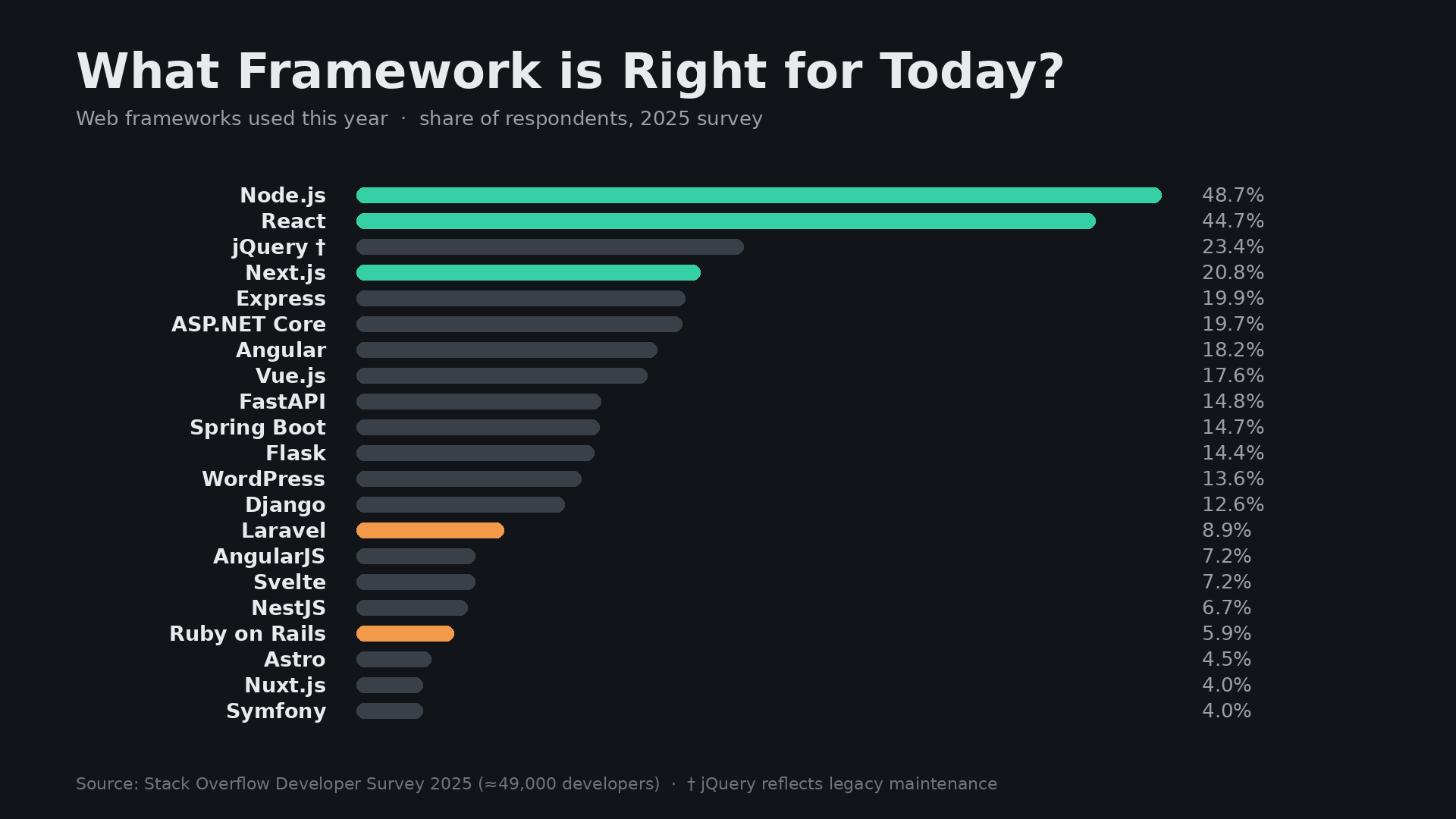
TLDR TypeScro[t and Convention over configuration seem to be a key thread for success
Frameworks are great until they are not, many of them have highly opinionated leaders that keep them from changing or going in directions that you personally might want to go or some are just too complex. I have used many of them in my career starting in Drupal, loving Ruby on Rails, building a lot of my career on Laravel and the going with any of the Javascript frameworks on top of Supabase. Before I dig into a series on building - deploying etc - I wanted to do some review of where some of the main frameworks are today.
## React, Node.js and Next.js are today’s top three
Today’s top three web technologies
These are the ones I have been enjoying for a number of months now
React — a UI library
44.7% used it in 2025 · 177.7M weekly npm downloads · 85.0% usage in State of JS 2025
The unanimous pick: it leads across Stack Overflow, State of JS and npm.
Node.js — technically a runtime
48.7% used it in 2025 — the #1 technology overall in Stack Overflow’s survey
The dominant server-side web platform in every developer survey; npm’s Express and Next.js downloads ride on it.
Next.js
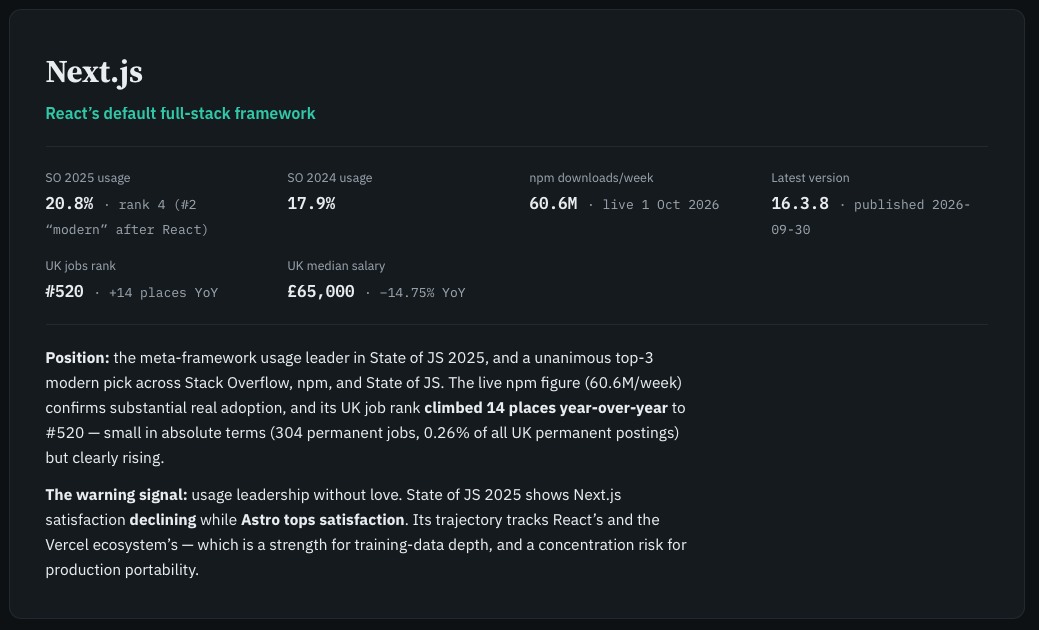
20.8% used it in 2025 · 60.6M weekly npm downloads · meta-framework usage leader in State of JS 2025
React’s default full-stack framework; Stack Overflow, npm and State of JS agree.
† Why isn’t jQuery here? It ranks 3rd in raw SO 2025 usage (23.4%) but is excluded from the verdict: that usage is overwhelmingly legacy maintenance, not new-project choice.
Among full-stack and backend frameworks, Express (19.9% SO usage; 134.4M weekly npm downloads) is the clear leader — and FastAPI is the fastest riser, jumping roughly 5 percentage points year-over-year in the Stack Overflow survey.
Framework-only top 3
Next.js — 20.8%
Express — 19.9%
ASP.NET Core — 19.7%
Metric: share of all Stack Overflow 2025 respondents who used it; libraries and runtimes (React, Node.js) excluded along with jQuery (legacy). For context: Laravel ranks #14 overall (8.9%), Ruby on Rails #18 (5.9%).
Where the sources agree — and where they disagree
“Popular” depends on what you measure: what developers use, what gets downloaded, what runs in production, or what gets hired. The sources disagree most about PHP — and that disagreement is the most interesting finding.
Every lens agrees
The JS/TS ecosystem dominates. Stack Overflow usage, State of JS, npm volumes, GitHub Octoverse (TypeScript became the #1 contributor language), RedMonk (JavaScript #1) and job postings (JS + TypeScript ≈ 30%) all say the same thing.
Python is #1 for learning, #2 for doing. It tops tutorial-search shares (PYPL 52%, TIOBE #1) while Stack Overflow and GitHub show it as a strong second — consistent, not contradictory.
Where they disagree
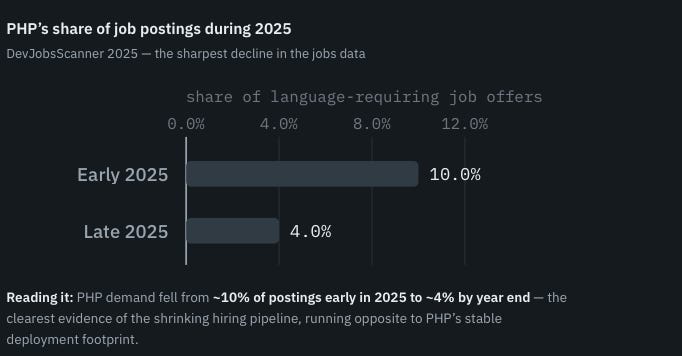
The PHP paradox. PHP is #4 in RedMonk and runs 69.9% of websites with a known server-side language — the vast weight of deployed code. But only 18.9% of SO developers use it, TIOBE ranks it #14, and its share of job postings fell from ~10% to ~4% during 2025. Both are true: PHP dominates existing deployments while losing the new-developer and hiring pipeline.
npm counts are snapshots, not census. Weekly downloads swing ±10–20% and are inflated by CI and transitive installs — the ordering (react > express > next > vue > angular) is the reliable signal.
Laravel’s absolute website counts conflict across BuiltWith’s own pages (362k vs 856k vs 1.3M) — only its country ranking order is usable.
One note there is “CI and transitive installs” when people show off the downloads of their repo this is key, those can be GitHub actions downloading as well.
The evidence, source by source
Every panel names its source, its date, its sample, and its caveats. Numbers travel with the methodology that produced them.
2.1Stack Overflow Developer Survey 2025
Published July 2025 · ~49,000 respondents · “Used this year” for web technologies. Source: survey.stackoverflow.co/2025/technology
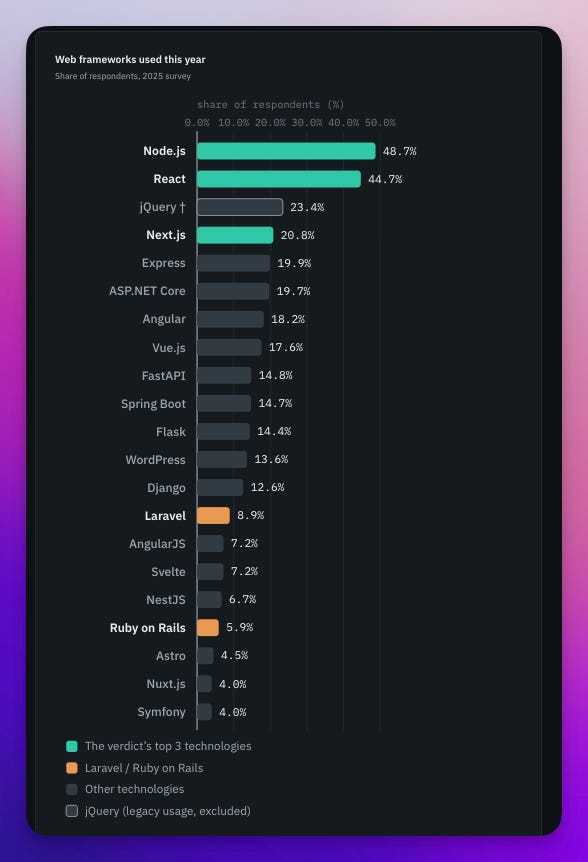
Reading it: the “top 3 overall technologies” are highlighted in green; Laravel and Ruby on Rails in orange; † jQuery (hatched) is excluded from the verdict — legacy maintenance, not new-project choice. FastAPI’s +5 pp year-over-year jump was, in Stack Overflow’s words, “one of the most significant shifts in the web framework space.”
Computed over the plotted data — leader: Node.js (48.7%) · Laravel ranks #14 (8.9%) · Ruby on Rails #18 (5.9%)
Caveat: the survey skews toward people who use Stack Overflow; the PHP and Laravel communities are under-represented there.
Languages (SO 2025): JavaScript 66%, Python 57.9% (+7 pp year-over-year), TypeScript 43.6%, Java 29.4%, C# 27.8%, PHP 18.9%, Go 16.4%, Rust 14.8%. 2024 comparison (65k respondents): Node.js 40.8%, React 39.5%, jQuery 21.4%, Next.js 17.9%, Express 17.8%.
Admired vs desired (frontend): most admired — Svelte 62.4%, React 52.1%, Vue 50.9%, Angular 44.7%. Most desired — React 30.7%. The single confirmed most-admired web framework figure is Phoenix (Elixir) at 79%; per-framework admired/desired numbers for Next.js, Laravel, Rails, Django and Express individually could not be verified.
npm weekly downloads
Read directly from the live package pages on npmjs.com/package/… · verified live 1 October 2026. Snapshot, not a stable average.
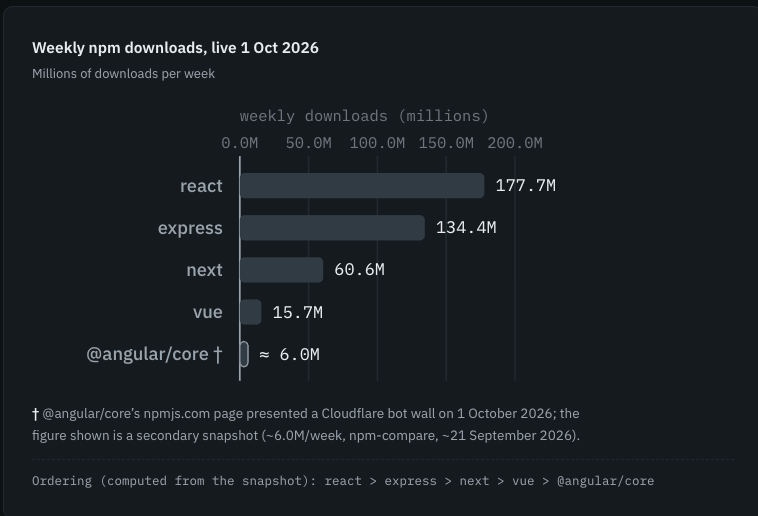
Exact live counts and the latest version shown, 1 Oct 2026.
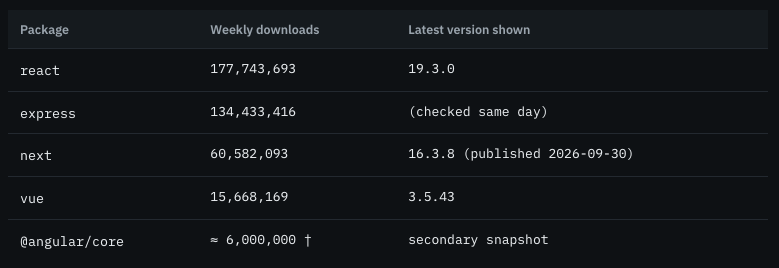
Caveats: these move ±10–20% week to week and are inflated by CI pipelines and transitive installs — use them for ordering, not headcounts. Earlier secondaries disagreed on absolute levels (a September 2026 secondary claimed express 101.5M/week and next 42.7M/week; a March 2026 blog claimed next ~9M/week), but the order is identical everywhere: react > express > next > vue > angular. Treat the older figures as stale or volatility artifacts.
GitHub Octoverse 2025
Released 28 October 2025 · data through August 2025 · language standings by contributor count. Source: github.blog — Inside GitHub’s newest Octoverse report
TypeScript became the #1 most-used language by contributors, overtaking Python and JavaScript in August 2025 — “the most significant language shift in more than a decade.”
Contributor growth: TypeScript +1.05M (+66.63% year-over-year), Python +850k (+48.78%), JavaScript +427k (+24.79%).
Nearly 80% of new repositories are in just 6 languages: Python, JavaScript, TypeScript, Java, C++, C#.
1.1M+ repositories use LLM SDKs (+178% year-over-year); ~80% of new developers use Copilot in their first week; 518.7M pull requests merged (+29%). GitHub attributes much of the surge to AI.
Octoverse 2024 top 10 for context: Python (which ended JavaScript’s 10-year reign), JavaScript, TypeScript, Java, C#, C++, PHP, Shell, C, Go.
Relevant to the AI question: the report notes Next.js 15, SvelteKit 2, Qwik and Astro 3 as scaffolding TypeScript by default — the modern web stack is converging on typed JavaScript.
State of JS 2025 (and 2024)
14,015 respondents in Dec 2024 · 13,002 responses in Feb 2026 (2025 edition). Sources: front-end frameworks and meta-frameworks (2025); 2024 front-end.
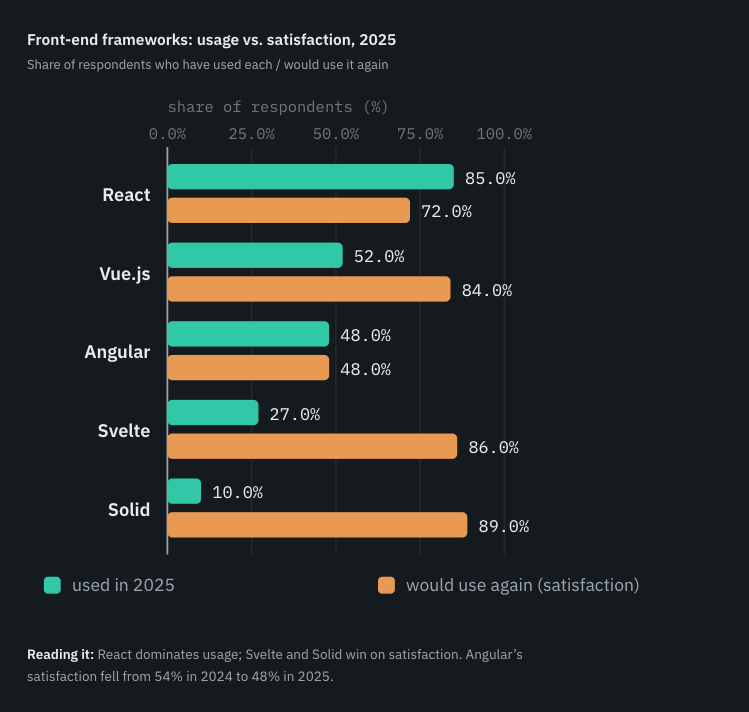
2024 for comparison (usage / satisfaction): React 82%/75%, Vue 51%/87%, Angular 50%/54%, Svelte 26%/88%, Solid 9%/90%.
Meta-frameworks (2025): Next.js still leads usage but its satisfaction is declining; Astro tops satisfaction — usage leadership without love. Back-end (2025): Express remains the usage leader; NestJS is “progressing at a nice clip”; Hono tops satisfaction.
Language indices: TIOBE, PYPL, RedMonk
Three independent measures of language standing, each measuring something different. Sources: TIOBE Index, September 2026 (search-engine based) · PYPL, September 2026 (tutorial-search share) · RedMonk, January 2026 (GitHub + Stack Overflow discussion).
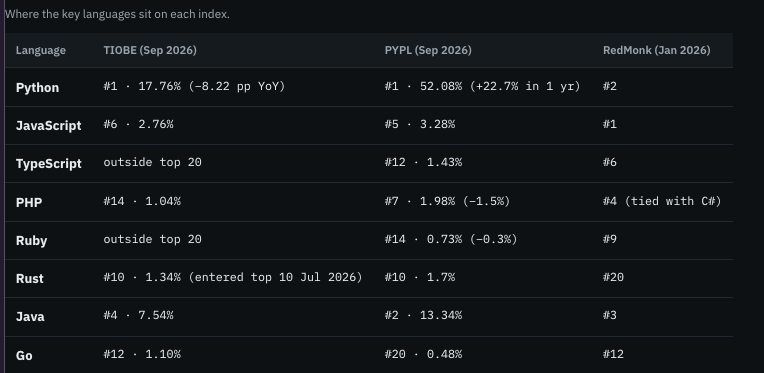
Reading it: PHP at #4 in RedMonk (which counts code and discussion volume, where legacy PHP is massive) vs #14 in TIOBE (search interest) is a methodology gap, not a contradiction — the same PHP paradox from §1. RedMonk explicitly notes its ranking is “not a statistically valid representation of current usage”, flags Stack Overflow’s declining query volume as a weakening signal, and says AI coding assistants have not yet visibly shifted language distribution. TIOBE’s 2026 highlight: Rust first entered the top 10 in July 2026.
W3Techs: server-side languages on the web
September 2026 · share of websites whose server-side language is known. This measures what the web actually runs on — overwhelmingly legacy deployments. Source: w3techs.com server-side language comparison
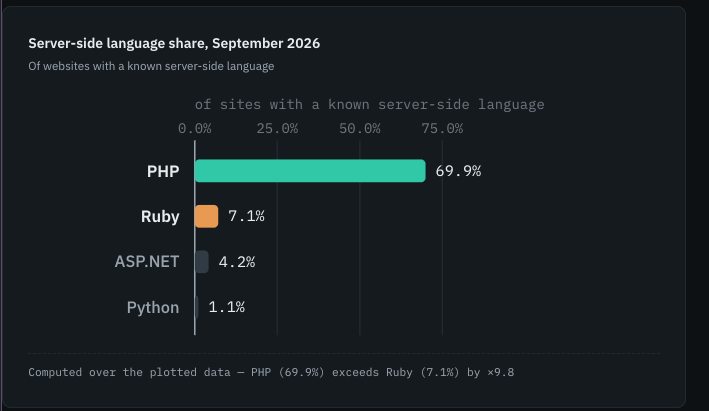
Where is node in this chart?
It’s not on that chart because W3Techs files Node.js under web servers, not server-side languages. On that lens, W3Techs has Node.js at 6.4% of sites with a known web server (June 2026), rising to 10.4% among the top 1M sites.
Two reasons it’s so much lower than PHP’s 69.9% there:
Category quirk — the chart you screenshotted only covers “server-side programming languages.” Node is counted one tab over, as server software.
Fingerprinting bias — W3Techs detects tech by visible fingerprints (
.phpURLs,X-Powered-Byheaders, generator meta tags). WordPress/PHP scream their identity; a Node app behind Nginx or Cloudflare exposes nothing, so Node is structurally undercounted.
That’s exactly why the two charts seem to contradict each other: the developer survey (Node #1 at 48.7%) measures what people build with, while W3Techs measures what leaks detectable fingerprints on the public web. Both true, different lenses.
Jobs: what employers are hiring for
DevJobsScanner 2025 (analysis of job postings through 2025) and ITJobsWatch UK (6 months to 28 Sep 2026). Sources: devjobsscanner.com · itjobswatch — Next.js
JavaScript + TypeScript ≈ 30% of job offers that explicitly require a programming language — “nearly 1 in 3.” Python 2nd, Java 3rd. (DevJobsScanner 2025)
Next.js (UK): rank 520, up 14 places year-over-year — 304 permanent jobs, 0.26% of all UK permanent postings, median salary £65,000 (−14.75% YoY). (ITJobsWatch, 6 months to 28 Sep 2026)
Laravel on ITJobsWatch: only small regional samples — insufficient for a figure. Another data point in itself.
JetBrains State of Developer Ecosystem 2025
October 2025 · 24,500+ responses, weighted. Source: blog.jetbrains.com/research/2025/10/state-of-developer-ecosystem-2025
PHP frameworks: Laravel 64%, WordPress 25%, Symfony 23% — Laravel is the unambiguous PHP framework leader.
Python frameworks: FastAPI tops at 38% (2024 usage); Django and Flask “remain strong.”
AI: 85% use AI regularly; ChatGPT most popular at 41% (down from 49% in 2024); 68% expect AI proficiency to become a job requirement; 23% worry about low-quality generated code.
The controversy: PHP and Ruby were initially classed as in “long term decline”; JetBrains then published a follow-up describing PHP as a “stable, professional, and evolving ecosystem” (covered by The Register).
Laravel-specific ecosystem notes in the coverage: Laravel Cloud and Laravel Boost / MCP AI integrations launched — Laravel is explicitly investing in the AI-assisted-development angle.
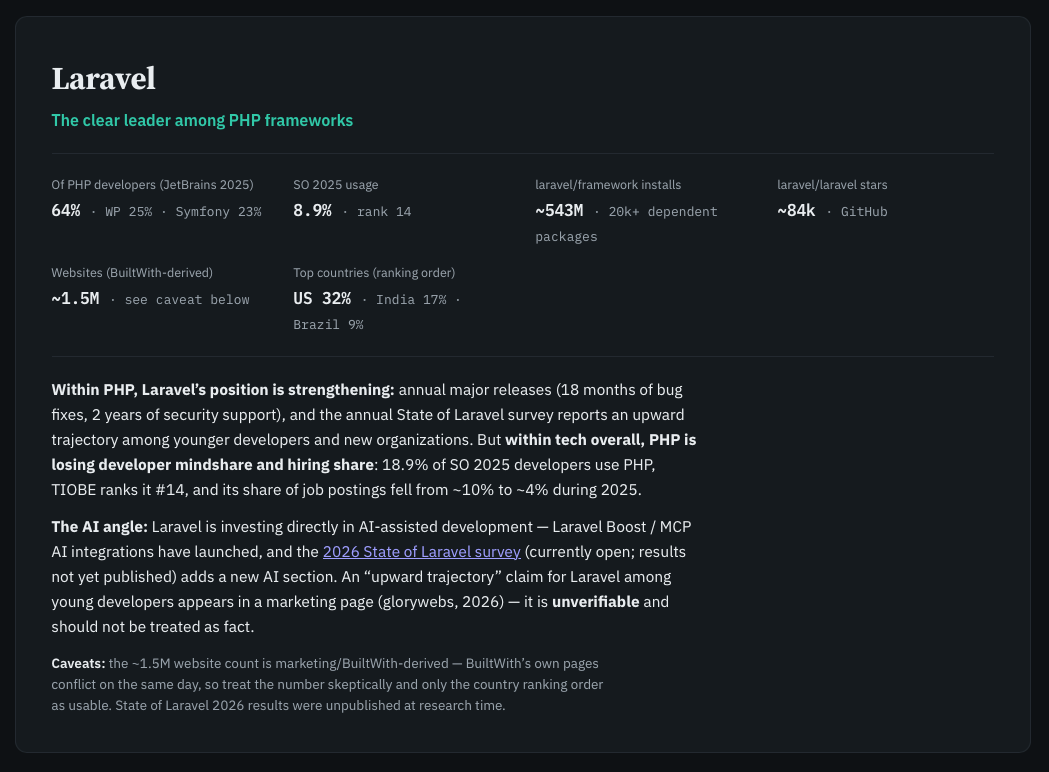
The State of Laravel Survey here
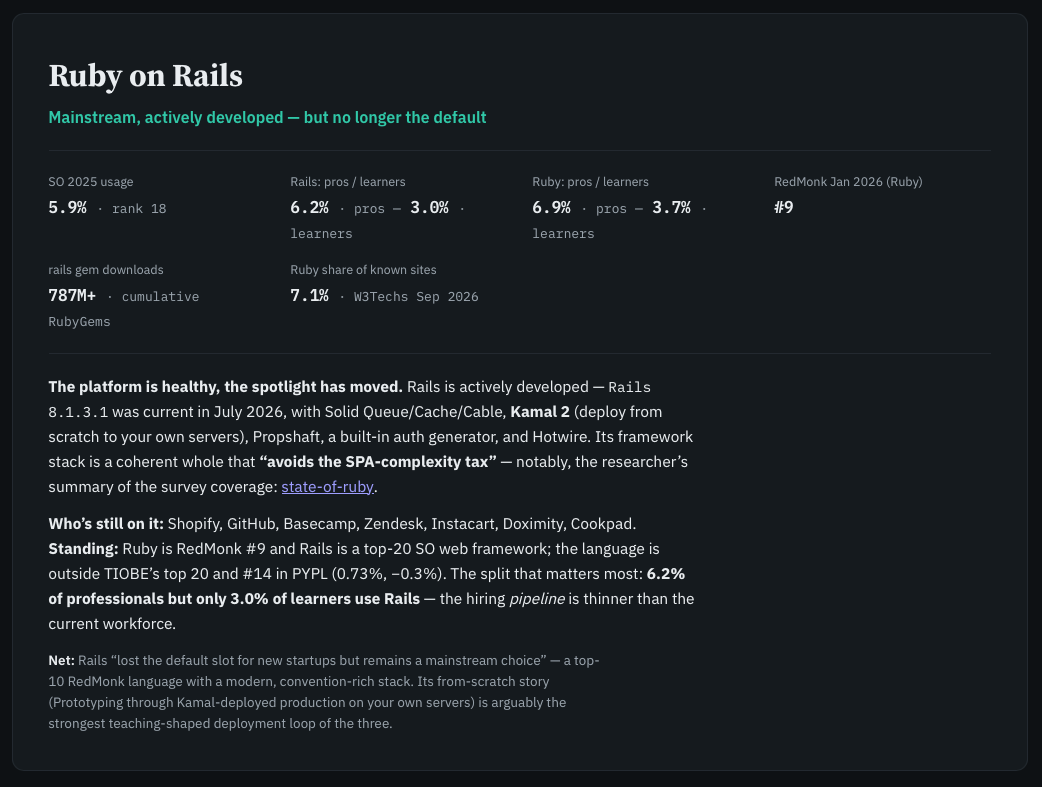
The State of Ruby here
Which frameworks do AI coding assistants handle best?
Framework complexity influences AI code quality
A 2026 MDPI longitudinal study found coding assistants performed better on client-side React.js than on server-side .NET Core: “framework complexity influences AI code generation quality” — attributed to .NET complexity plus the much greater JavaScript training data. The same line of research warns that AI output needs verification: ~40% of Copilot-generated programs in security scenarios contained exploitable vulnerabilities.
Node.js had the highest compatibility with AI-generated code
A Theseus.fi thesis (May 2025) crossed ChatGPT, DeepSeek, Gemini and Copilot with Node.js, Flask, .NET and Laravel: “Node.js exhibited the highest compatibility with AI-generated code, while .NET demonstrated superior correctness and maintainability.”Laravel was in the study and did not take the top slot.
Typed code gets the biggest AI payoff
GitHub Octoverse 2025 reports that 94% of LLM compilation errors were type-check failures — typed, convention-driven code benefits most from AI generation. With TypeScript now the #1 contributor language and the modern web scaffolds (Next.js 15, SvelteKit 2, Astro 3…) defaulting to it, the TypeScript ecosystem is where AI assistance converges with developer momentum.
Context: 1.1M+ repos use LLM SDKs (+178% YoY); ~80% of new developers use Copilot in their first week (Octoverse). JetBrains 2025: 85% use AI regularly, and 68% expect AI proficiency to become a job requirement.
Research gap — the hypothesis behind your question is untested
The natural intuition — that convention-over-configuration frameworks (Rails, Laravel) produce better AI-generated code because a single standard way of doing things is easier for an LLM to emulate — has no published benchmark behind it. The researchers found no study measuring it; it remains “a plausible hypothesis,” flagged as a research gap. Conventions help reasoning (see F3); but the convention-over-configuration claim specifically has no measured support.
Your question: which framework should you teach with?
Two goals — helping students understand the normal stuff and helping them guide an AI to do it — and the data does not give them the same answer. What follows is synthesized from the evidence above; nothing here adds data the sources don’t carry.
A - Next.js + TypeScript (React)
If the priority is guiding an AI to do the normal stuff reliably — the strongest AI case in the data.
Deepest training footprint, by every measure: #1 modern pick across Stack Overflow, State of JS and npm — and LLMs are best at exactly this stack (MDPI 2026; React beat .NET Core on AI code quality).
Types make AI output verifiable: 94% of LLM compilation errors are type-check failures — the typed TypeScript flow turns AI output into compilable-or-not, a fast correctness filter. (Octoverse 2025)
Node.js had the highest compatibility with AI-generated code of the stacks tested head-to-head. (Theseus, May 2025)
Caveat: State of JS shows Next.js satisfaction declining even as usage leads; the platform’s center of gravity (Vercel) is more vendor-shaped than the self-host story in option B.
B - Ruby on Rails 8
If the priority is teaching people the full ladder — build from scratch, deploy, host, everything — the strongest teaching-shaped loop in the data.
Convention over configuration means there’s one documented “normal way” — your instinct is directionally right, and its full-stack coherence “avoids the SPA-complexity tax” that muddies beginner curricula.
Kamal 2 gives the deploy-from-scratch story: build → deploy → host on your own servers from Rails’ defaults — an end-to-end loop the other options don’t bundle as a first-class narrative.
Built-in auth generator, Solid* primitives, Hotwire: the things beginners reach for are batteries inside the box.
Caveat: the conventions-help-AI hypothesis is untested (no published benchmark — see the research gap above), and Rails’ AI training footprint is thinner than JS/TS. 5.9% SO usage with 6.2% pros / 3.0% learners also means students finish in a friendly but no-longer-default job market.
C - Laravel
PHP’s unambiguous winner.
64% of PHP developers — the clear PHP framework leader, with Laravel Cloud and Laravel Boost/MCP AI integrations showing deliberate investment in AI-assisted development. (JetBrains 2025)
Caveat: PHP dominates what’s already deployed (69.9% of known server-side sites), but its hiring pipeline shrank from ~10% to ~4% of postings during 2025. Laravel was in the Theseus AI study and did not top compatibility. The quoted “upward trajectory” claim is marketing-sourced and unverifiable.
The split: if the priority is that an AI can do the normal stuff reliably, the data favors Next.js + TypeScript. If the priority is teaching the full ladder from scratch to self-hosted production, Rails 8 with Kamal offers the strongest end-to-end teaching story of the three.
Both readings are defensible from the same evidence; which to teach depends on whether your students will lean more on AI assistance or on owning servers end to end.
What this could not verify
Per-framework Stack Overflow admired/desired figures for Next.js, Laravel, Rails, Django and Express — the survey page’s charts don’t expose these as text. Only the most-admired overall (Phoenix, 79%) is confirmed. Would need the interactive page’s chart data or Stack Overflow’s data explorer.
Live @angular/core npm figure — npmjs.com showed a Cloudflare bot wall on 1 October 2026 (not retried). A secondary snapshot (~6.0M/week, npm-compare, ~21 Sep 2026) is used instead.
BuiltWith absolute Laravel counts — contradictory across BuiltWith’s own pages on the same day (362k vs 856k vs 1.3M). Only the country ranking order is usable.
State of Laravel 2026 survey results — the survey opened in September 2026; results are not yet published. The “upward trajectory among young developers” claim is marketing-sourced and unverifiable.
The conventions-help-AI claim — no published benchmark shows convention-over-configuration frameworks (Rails, Laravel) produce better AI-generated code. A research gap.
npm absolute volumes — weekly downloads are volatile (±10–20%) and inflated by CI/transitive installs; the live numbers are a 1 October 2026 snapshot, not a stable average.
Sources
Every figure above comes from one of these, read on 1 October 2026. Flags from the research: “verified live” = read in a live browser; “index” = via search-index text fetch.
Stack Overflow Developer Survey 2025 index — published July 2025, ~49k respondents.
https://survey.stackoverflow.co/2025/technology/npmjs.com live package pages verified live 1 Oct 2026 — react 177,743,693/wk · express 134,433,416/wk · next 60,582,093/wk (v16.3.8) · vue 15,668,169/wk (v3.5.43).
Read directly from the live package pages (npmjs.com/package/{express,next,react,vue}) on 1 October 2026GitHub Octoverse 2025 announcement index — released 28 Oct 2025; data through Aug 2025.
https://github.blog/open-source/git/inside-githubs-newest-octoverse-report/State of JS 2025 index — Feb 2026, 13,002 respondents.
https://2025.stateofjs.com/en-US/libraries/front-end-frameworks/
https://2025.stateofjs.com/en-US/libraries/meta-frameworks/State of JS 2024 index — Dec 2024, 14,015 respondents.
https://2024.stateofjs.com/en-US/libraries/front-end-frameworks/TIOBE Index, September 2026 index — search-engine based.
http://www.tiobe.com/tiobe-indexPYPL, September 2026 index — tutorial-search share.
https://pypl.github.io/PYPL.htmlRedMonk Language Rankings, January 2026 index — published 14 Apr 2026; GitHub + Stack Overflow.
https://redmonk.com/sogrady/2026/04/14/language-rankings-1-26/W3Techs server-side language comparison index — September 2026.
https://w3techs.com/technologies/comparison/pl-php,pl-rubyJetBrains State of Developer Ecosystem 2025 index — Oct 2025, 24,500+ responses.
https://blog.jetbrains.com/research/2025/10/state-of-developer-ecosystem-2025/DevJobsScanner 2025 index — analysis of job postings through 2025.
https://www.devjobsscanner.com/blog/top-8-most-demanded-programming-languages/ITJobsWatch UK — Next.js index — 6 months to 28 Sep 2026.
https://www.itjobswatch.co.uk/contracts/uk/next.js.doState of Laravel 2026 survey (open) index — opened Sep 2026; results not yet published.
https://laravel-news.com/state-of-laravel-2026-surveyLaravel usage statistics 2026 (glorywebs) index — marketing source; treat with caution.
https://www.glorywebs.com/blog/laravel-usage-statisticsState of PHP / Laravel analysis, June 2026 index — Packagist/star figures.
https://github.com/ernie55ernie/ernie55ernie.github.io/blob/HEAD/_posts/2026-06-29-state-of-php.mdLaravel usage-by-country research (BuiltWith caveats) index.
https://github.com/vitou-vitou/laravel13.x/blob/HEAD/docs/research/laravel-usage-by-country.mdState of Ruby 2026 (draft) index.
https://paolino.me/posts/draft/2025/10/12/state-of-ruby-in-2026/Toptal: Symfony vs Laravel index.
https://www.toptal.com/developers/php/choosing-between-symfony-and-laravel-frameworks